Focused Process Safety Modules for Continuous Professional Upskilling (Upcoming)
The Weekly Certificate Courses are designed for working professionals, engineers, and safety practitioners who want to upgrade their process safety skills without committing to long-term programs. These short, intensive modules focus on core process safety tools and methodologies that are widely used across high-risk industries such as oil & gas, chemicals, petrochemicals, pharmaceuticals, fertilizers, and power plants.
Each course is structured to deliver practical, immediately applicable knowledge, making it ideal for professionals who want to strengthen their technical competence, improve on-the-job performance, and enhance career credibility..
Why Weekly Certificate Courses?
Short duration with high learning impact
Designed for busy professionals
Strong focus on real industrial applications
Covers globally accepted process safety methodologies
Ideal for continuous professional development (CPD)
Certificates awarded after successful completion
These courses allow participants to learn, apply, and progress—one skill at a time.
Available Weekly Certificate Modules
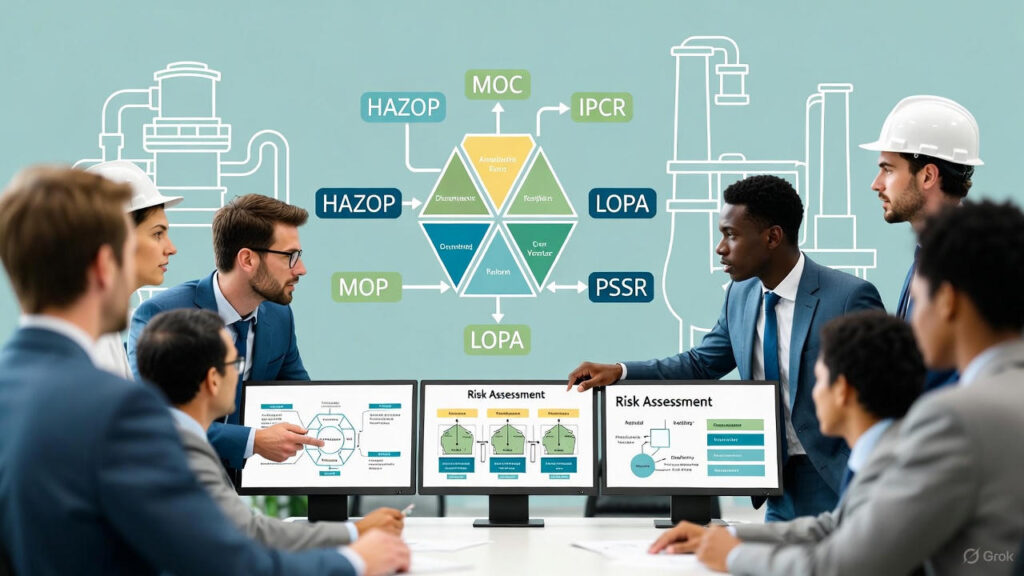
🔹 HAZOP (Hazard and Operability Study)
This module provides in-depth training on systematic hazard identification and operability analysis of process plants.
Key learning areas include:
- HAZOP philosophy and objectives
- Node selection and guide words
- Identification of deviations and consequences
- Safeguards, recommendations, and action tracking
- Role of HAZOP team members
- Practical HAZOP case studies
Participants gain the ability to actively participate in or lead HAZOP studies in real industrial environments.
🔹 MOC (Management of Change)
The MOC course focuses on managing technical, organizational, and operational changes safely, ensuring that modifications do not introduce new risks.
Key learning areas include:
- Importance of MOC in accident prevention
- Types of changes requiring MOC
- MOC workflow and documentation
- Risk assessment during change
- Authorization, communication, and closure
- Common MOC failures and lessons learned
This course strengthens a participant’s capability to implement and control change safely and systematically.
🔹 LOPA (Layers of Protection Analysis)
LOPA is a semi-quantitative risk assessment tool used to evaluate whether existing safeguards are sufficient.
Key learning areas include:
- Relationship between HAZOP and LOPA
- Identification of initiating events
- Independent Protection Layers (IPLs)
- Risk tolerance criteria
- LOPA calculations and decision-making
- Practical examples from process industries
Participants learn how to justify safety decisions using risk-based methodologies.
🔹 PSSR (Pre-Startup Safety Review)
This module focuses on ensuring that new or modified facilities are safe before startup.
Key learning areas include:
- Objectives and regulatory importance of PSSR
- PSSR checklists and prerequisites
- Verification of procedures, training, and safeguards
- Interface with MOC and commissioning
- Common PSSR gaps and best practices
Participants gain the skills required to conduct structured and effective PSSR activities.
🔹 Risk Assessment
This course builds strong fundamentals in identifying, analyzing, and controlling workplace and process risks.
Key learning areas include:
- Hazard identification techniques
- Risk matrices and ranking
- Qualitative and semi-quantitative methods
- Control measures and hierarchy of controls
- Documentation and review
- Practical risk assessment exercises
The module enhances a professional’s ability to make informed safety decisions across operations and maintenance activities.
Who Should Attend
These weekly certificate courses are suitable for:
- Process, chemical, mechanical, and electrical engineers
- HSE and safety professionals
- Operations and maintenance personnel
- Production supervisors and managers
- Quality, reliability, and asset integrity teams
- Fresh graduates seeking industry-relevant skills
Learning Methodology
- Expert-led interactive sessions
- Real industrial case studies
- Practical exercises and examples
- Industry-relevant templates and checklists
- Assessments to validate understanding
Each module is designed to ensure that participants not only understand the concepts but can apply them confidently at work.
Certification
Participants who successfully complete the module and assessment receive a Certificate of Completion, demonstrating competency in the specific process safety discipline. These certificates add value to professional profiles, resumes, and compliance records.
Career & Professional Benefits
- Improved technical confidence
- Better participation in safety studies and audits
- Enhanced compliance knowledge
- Strong foundation for advanced process safety roles
- Ideal stepping stone toward advanced diplomas and certifications
Conclusion
The Weekly Certificate Courses provide a practical, flexible, and effective pathway for continuous learning in process safety. Whether you want to strengthen a specific skill or gradually build a strong safety portfolio, these focused modules help you stay competent, compliant, and career-ready in today’s high-risk industrial environment.